As an existing iPO investor, you are of course aware that one of the primary goals of the iPO is to allow for the company to be broadly owned by our customers and investors (as opposed to the traditional path of being owned by a small number of large institutions). As part of this, we tend to limit when and how much individuals are able to invest.
However, we also receive frequent requests from inventors who wish to invest more in the iPO and so, on occasion, we provide existing iPO investors the opportunity to purchase additional shares.
We are happy to let you know that we plan on opening a window for certain existing investors to purchase additional iPO shares beginning next week.
Note: Since it’s been over a year since some of you first invested, we thought it would be valuable to restate our mission and vision for the business, as well as give you a brief update on how we feel we’re positioned going forward.
The below letter is one that we created and have shared recently with first-time iPO investors. In addition, we’ve made some recent updates to the iPO offering page that can be found here.
--
Letter to First-Time iPO Investors
Technology inevitably disrupts every industry. We’ve seen it over and over again — in commerce, media, advertising, computing, communication, and even work itself. Today, there remain only a few great bastions still resisting this revolution — airlines, automobiles, energy, real estate, and capital formation to name a few. These industries have been more resistant to current technology because, as companies like Tesla have shown, they are more capital intensive and therefore require enormous outlays of risk capital to achieve the scale necessary to deliver a truly disruptive product.
From the beginning, our mission has been to build a better financial system — one that works on behalf of individuals rather than at their expense. But the financial system itself is enormous, far too large to consume all at once. And it is complex, full of arcane regulation, hardly changed over the past century.
To succeed, we recognized that we would need two things:
- To attack the problem as one would eat an elephant, one step at a time
- A source of capital that was both patient and aligned with our long-term mission
The Fundrise iPO (internet public offering), a wholly unique ownership model whereby individual investors on Fundrise are given the opportunity to become investors in the company itself is our solution to the second of these requirements.
But first, more information on how we are eating the elephant…
Where we started
The financial system, at its most basic level, is made up of three component parts:
- Distribution
- Investment (or allocation)
- Production
And while the glory may lie in investment or allocation, the power is actually in the distribution and production.
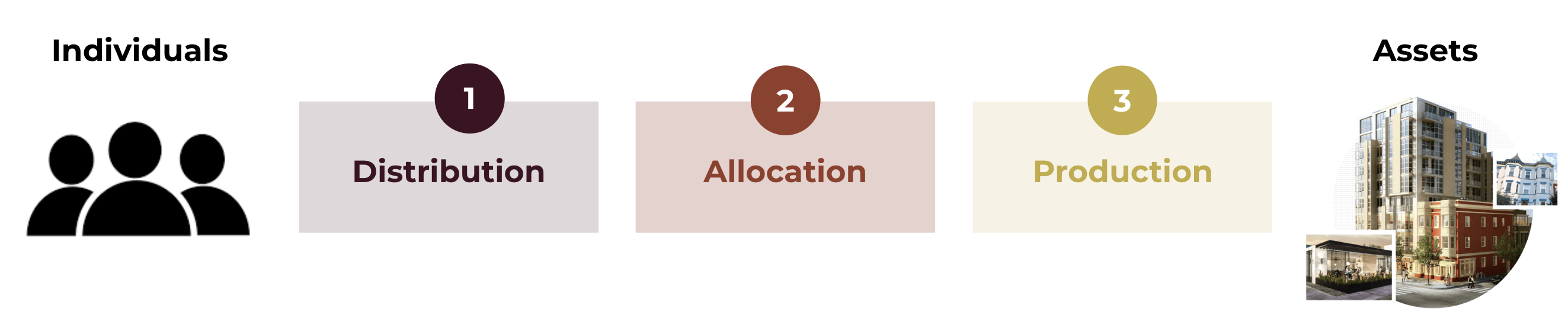
We started by rebuilding the distribution phase because, at the time, we believed it was the most ripe for disruption. The internet had created a new channel by which to communicate and interact with customers, and through our app and web platform, we unlocked an entirely new asset class for individual investors. We then paired this customer interface with our own backend infrastructure, leveraging software, to drive down the marginal cost of investment to nearly zero. As a result, we were able to bring the minimum investment down from the traditional hundreds of thousands to only $10, and for the first time (in our opinion) truly democratize access to the private real estate market.
This process of opening up private markets to individuals is, on its own, a big business.
Distribution (aka fundraising) is power because ultimately he or she who writes the checks makes the decisions. And unlike most investment managers who distribute their investments through an army of salespeople, we at Fundrise have formed direct relationships with hundreds of thousands of individuals.
And “hundreds of thousands” is just a start. There are tens of millions of investors who will need access to private markets over the next several years and decades.
However, as we’ve said, the mission of Fundrise — and its true, deeper potential — lies in disrupting not only one step of the chain but the entire financial system itself.
Where we’re going
Over the past several years, our energy and attention has increasingly expanded to redesigning and rebuilding both the investment/allocation and production/operation components of the value chain. And while we still have a lot left to do, we have at this point created (to our knowledge) the first truly end-to-end software platform connecting the dollars entrusted to us by our investors directly to the assets we are investing in and operating on their behalf.
And while the benefits, both existing and future, are numerous, two simple measures of the value of our system come in the form of (i) greater overall efficiency (or reduced costs) as a result of vertical integration, and lower overall fees; and (ii) alignment of the decisions made at each step of the chain, back up to what is in the best interest of our investors.
It’s become clear to us that we are building a much different company than most in the financial industry appreciate (something we think is a good thing). This is probably because most fintech companies to date have been more hype than substance, essentially acting as shiny digital wrappers of the same underlying systems and products.
Nearly every financial institution or traditional investment manager we’ve talked to over the years has suggested the “brilliant” idea that we simply hand over to them, the “experts,” the money from our investors, so that they could put it into their own funds or investments — with, of course, a healthy markup and fee load along the way. These institutions saw our investors as an opportunity, easy prey to be taken advantage of, because they thought we and our investors wouldn’t know any better.
This is largely why we never raised growth equity from traditional financial organizations. The ring of power is too great a temptation.
Instead, we created the Fundrise iPO, giving our investors the opportunity to invest in and become owners of Fundrise itself, and in doing so align the interests of the shareholders of Fundrise with the interests of our customers, by making them one and the same.
--
In case you missed it, I hope you’ll take the time to read our two year-end letters — one to all investors and one to iPO investors. These will provide the best, most in-depth perspective on how we feel the company and portfolio are positioned, as well as the challenges and opportunities ahead of us.
In the meantime, if you have any questions, please feel free to reach out to investments@fundrise.com.
Onward,
Ben and the entire Fundrise Team
Frequently asked questions
What is the price per share of the Fundrise iPO?
The current price per share is $15.90. This represents a 5% increase from the last time we updated the price ($15.15 in June of 2022) and we believe is a reasonable reflection of our growth through an incredibly turbulent economic period.
Investments can only be made into the iPO in the form of whole shares (no partial or fractional shares can be purchased), which is why you’ll notice your minimum investment is not a round number.
Is there any update on the timing of a public IPO (Initial Public Offering)?
A standard corporate metric for a successful IPO is to have at least $100 million in annual revenue with strong earnings or a clear path to profits. The best companies usually are growing more than 40% a year.
With nearly $60 million in annual revenue and 60% annual growth in 2022, Fundrise is on track. Our greatest challenge is to drive scale and profitability in an economic environment with depressed investor sentiment. Based on our current trajectory, we believe it will require at least 24 months before the company will achieve these key metrics.
How is my maximum investment determined?
You can invest up to, but not in excess of, the cost basis of your existing non-iPO investments on the platform. As a reminder, this is inclusive of any existing iPO positions. Take the following table as a hypothetical, illustrative example:
Hypothetical / Illustrative Scenario
| Non-iPO cost basis (iPO Limit) | $10,000 |
| Existing iPO Investment | $3,000 |
| Current Max iPO Investment | $7,000 |
If your existing iPO investment is currently at or above your non-iPO cost basis, you are not currently eligible to invest more in the iPO. You can login and view the offering page at any time to view a table just like this one with your personal account data.
How will I invest?
We will notify you when the offering becomes available, at which point you can log in to your account and place an investment from the offering page.
Any new Fundrise iPO investment will need to be funded with money from your external bank account. You cannot transfer any of the value of your non-iPO portfolio into iPO investment.