
These excerpts are being shared for informational purposes only and may not include all of the content contained in the original article. Fundrise was not involved in the authorship of this article and has not compensated anyone in connection with the publication of this article, including those providing quotes, who are neither solicitors nor promoters of Fundrise Advisors.
For the most recent publicly available total asset transaction value and other platform figures on Fundrise and its affiliates please refer to fundrise.com as well as Rise Companies Corp.’s public filings available on the Securities and Exchange Commission’s Edgar website.
--
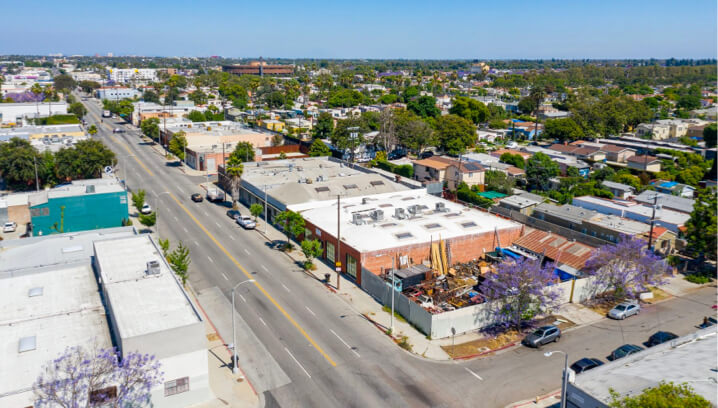
An aerial view of West Jefferson Boulevard in Los Angeles, where Fundrise is renovating office and retail space.
On a sleepy stretch of West Jefferson Boulevard not far from downtown Los Angeles, cars typically speed past blocks of old warehouses and blank retail facades for destinations elsewhere. But slow down, hit the sidewalk and peek into and around a few buildings, and you’ll see the telltale signs of renovation: sandblasted walls, new windows, work crews and exposed wood beams.
In an expansive brick building that once housed a child-care center before reverting to a warehouse, an inside-out renovation for a future food hall has stripped the wooden ceiling down to gorgeous bow trusses, sunlight filtering through the gaps and lighting up a floor of dirt filled with tracks from heavy machinery.
This string of commercial development, 20 buildings in total, isn’t a typical project, nor does it rely on traditional sources of financing. A clue can be found on the white and orange signs above a handful of buildings between La Brea Avenue and Crenshaw Boulevard, beckoning potential tenants to call Fundrise for leasing opportunities for built-to-suit office/retail.
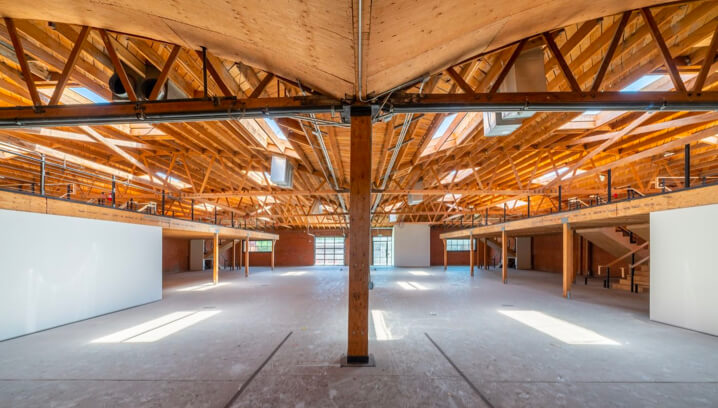
One of nearly two dozen old warehouses and workplaces being renovated for offices, retail and restaurants by Fundrise.
A Washington, D.C.-based online investment platform that “helps smart investors invest smarter,” Fundrise LLC boasts roughly $5.1 billion in real estate assets, including a sizable portion of this part of L.A. Initially part of a crowdfunding boom, the platform and app have pivoted to become a guided investment site, where roughly 150,000 users invest at least $500 each in a collection of portfolios and plans run by Fundrise professionals that focus on different properties types; recent investments include a $34 million industrial warehouse in Maryland and a push to build single-family rental homes in the Sun Belt.
Firm co-founder and Chief Executive Officer Benjamin Miller says that the technology allows everyday people to be investors and drive transformation. Fundrise is trying to build for their customers, he says, which allows the company to focus on longer-term returns with the luxury of picking and choosing tenants and waiting for the right opportunity. The company’s concentrated commercial project on West Jefferson is a new iteration of that model: mom-and-pop stores for mom-and-pop investors.
“Critical mass is critical to creating a sense of place,” said Miller. “If you drive down West Jeff, there still isn’t much going on. This is, ‘can we help build up a neighborhood?’”
Natalie Neith, a resident and local realtor since the ‘80s who hadn’t heard of Fundrise, says the greater neighborhood, better known as Jefferson Park, is best known for bungalows and historic homes lining nearby side streets, though it's beginning to see increased interest from developers. The main street of warehouses and former storefronts for furniture makers and upholsterers is ideal for more affordable creative office space and restaurants and retail, according to Miller and his staff.
West Jefferson lies east of Culver City and West Adams, blocks from an Expo Line light rail stop, just south of the 10 highway, and midway between downtown and the Westside of L.A. When Fundrise stumbled upon available buildings in 2017, the company figured, instead of just buying an asset, why not acquire, upgrade, lease and hold the space? With content studios such as Apple and Netflix moving into spaces in L.A.’s Culver City neighborhood and pushing out smaller tenants, they offered a great option for businesses looking for a new home in a post-pandemic recovery.
The Fundrise plan for West Jefferson has been slowed by the pandemic, and a mixed picture for commercial property — increasing construction costs and rising rents despite a glut of vacant office space — offers a potentially challenging backdrop for this project. But Fundrise views its endeavor as something unique. Giving new life to beautiful old buildings and creating something that relates to the streetscape, says Miller, is an entirely different project than some massive multistory redevelopment out of sync with the neighborhood that displaces residents via demolition.
Fundrise says that its investment model offers a solid, stable investment, focused on long-term, winning assets, such as recent apartment acquisitions that can outperform the stock market. In a first-quarter letter to investors, it described the process as akin to “planting seeds in the spring in anticipation of a harvest later in the year.” Critics have said that the platform’s lack of specialization hurts its overall performance, it doesn’t offer instant liquidity for investors, and won’t outperform publicly traded REITs.
But with the purchase of the West Jefferson buildings, Fundrise may have picked a neighborhood poised for growth. Nick Hadim, a local developer who has invested in the street since 1998, has focused on turning the run-down warehouse and workspaces into artist’s lofts. (He has a new project at 3300 W. Jefferson Boulevard in the works). Signs above a handful of buildings read Artist District, Hadim’s attempt at self-promotion, and tenants in his buildings include MagicSnow, which makes fake snow for malls.
“The buildings have good bones and good character,” he said, “When I started, after the riots, when they burnt a lot of buildings on Jefferson, the area was a little shady. It was pretty nasty, areas with overgrown landscapes. But 20 years ago, I said this would be the next Abbot Kinney [a trendy and expensive retail strip in Venice, California]. I knew it was going to happen.”
Fundrise actually called him about many of his properties, asking if he was interested in selling (he was not).
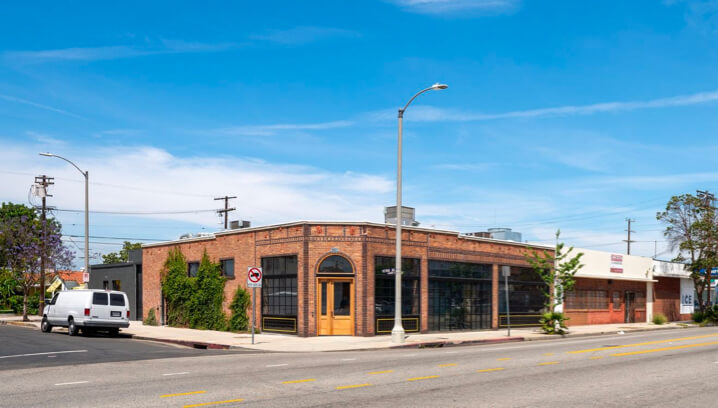
The Mass Appeal office on West Jefferson, the first of Fundrise’s properties to open. The company owns properties on each corner of this intersection.
Currently, just a handful of tenants occupy Fundrise buildings. A 5,000-square foot building that was formerly storage and office space is now home to Mass Appeal, the music and production company co-owned by rapper Nas. A set of swinging glass doors opens up onto the sidewalk at West Jefferson and Victoria. Fundrise owns every building touching that intersection, including a gas station and a small shack and former restaurant, Pete’s, with plenty of open space for a large patio.
In the rear of the Mass Appeal office, another tenant, Reparations Club, has been operating since last fall. The Black-owned, woman-owned bookstore, community space and concept shop — on select Saturday mornings, a communal cartoon-watching session takes place on its couches — is the unique vision of owner Jazzi McGilbert, a bibliophile and former editor at Teen Vogue and Nylon who grew up in South Central.
“Not a lot of spaces for young Black queer creatives, that was lacking for me growing up,” said McGilbert.
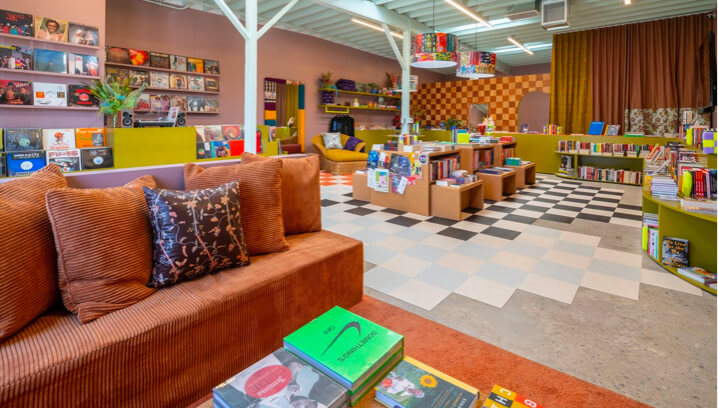
The interior of Reparations Club, a black- and woman-owned bookstore that founder Jazzi McGilbert says “feels like everybody’s little secret.”
After a previous location at Washington and LaBrea flooded over last Thanksgiving, and property values for commercial space started spiking, McGilbert started searching for a new home for Reparations Club and came across the West Jefferson space while riding around the city. After opening during the pandemic with mail-order and curbside service, the store has seen foot traffic from the neighborhood grow, and as McGilbert sees it, a good relationship with the area takes root.
“The fact I’m here suggests the neighborhood is going in a different direction,” she said about Fundrise’s impact on the area. “I like that we’re a little bit off the main road, and we don’t have signage yet. It feels like everybody’s little secret, everybody’s little hideaway, and we want to keep it that way.”